This is a personal story and a reflection that has stayed with me for well over a decade.
Stepping Across the Threshold: When a Language Becomes a Way of Thinking
Back around 2014, through a stroke of coincidence, I joined a foreign-owned company and found myself working alongside an international leadership team.
To be specific, both our CTO and CEO were native English speakers. Even though I had been self-studying English on and off since 2008, it was the first time in my life that I was truly pushed into an environment where deep, high-stakes collaboration had to happen entirely in another tongue.
It was during that period that I had a profound realization: Mastering a foreign language is never merely about acquiring a practical career skill or a bullet point on a resume. At its core, it gives you an entirely new way of thinking.
Languages never exist in a vacuum as dry code or isolated grammatical rules; they are soaked in the history, daily life philosophies, and cultural fabric of the people who speak them. When we only know our mother tongue, our perspective can easily become bounded without us even realizing it. We grow accustomed to interpreting everything through a single cultural framework, with our logical loops spinning within the walls of one familiar vernacular.
When you genuinely learn and use another language, however, you immerse yourself into another culture. It is like discovering a second axis on what used to be a flat, one-dimensional graph. With two contrasting reference points, you no longer see issues in plain black and white. You gain a second vantage point. And only with that contrast can your thinking expand in both breadth and depth.
When I first started self-studying back in 2008, memorizing vocabulary lists and grammatical patterns, I could never have imagined this dimension of learning. It only becomes clear when you actually start conversing in another person’s language, understanding the subtle cultural nuances behind their words, and connecting with them directly on their own terms. There is an unmistakable joy that comes from that—the quiet thrill of truly understanding someone, respecting their world, and meeting them right where they are.
That experience taught me just how precious and irreplaceable genuine human communication really is.
Abundant Tools, Shrinking Depth
Yet, looking around at the modern world we live in today, the contrast couldn’t be starker.
We have lived through the explosion of the internet, the rise of smartphones, and an endless stream of instant messaging apps. Today, we have entered the age of AI. Real-time speech translation, smart earbuds, and large language models can now translate complex dialogue across languages within a single second. The physical friction and technical barriers of cross-cultural communication have been lowered to a point unprecedented in human history.
Yet ironically, what I observe in day-to-day life is quite the opposite: Deep, meaningful conversations—the kind where people genuinely try to step into someone else’s shoes, embrace another worldview, and listen across cultural boundaries—seem to be getting rarer and rarer.
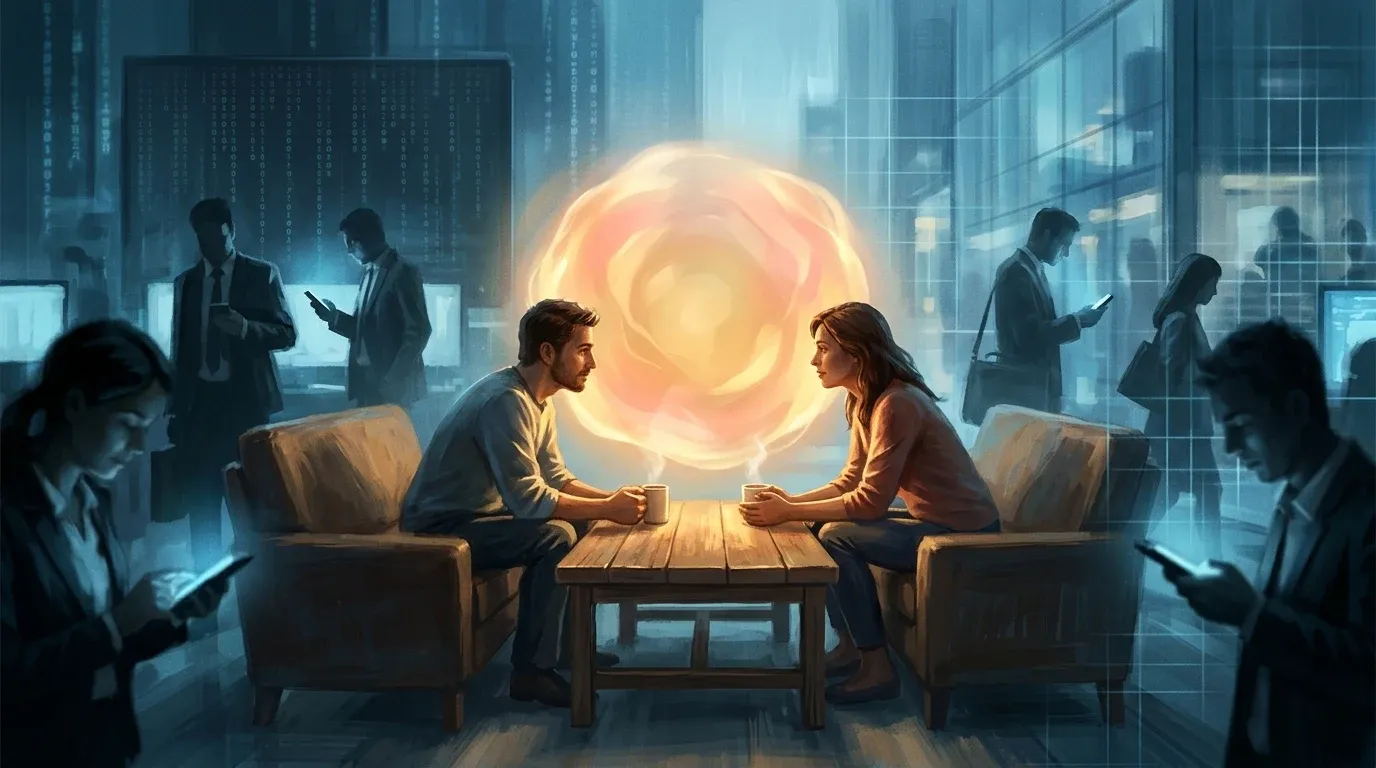
Almost everyone is holding a pocket-sized supercomputer capable of reaching anyone across the globe. Our feeds are constantly streaming an endless barrage of content. Yet sitting on a commuter train, waiting in a café, or even sitting around a dining table with close friends and family, you see the exact same scene: silence, downcast eyes, and minds lost in their own algorithmic islands. We have built the most sophisticated translation algorithms on earth, yet we seem to be losing the patience to walk across the room and listen to a living human being.
A Software Developer’s Dilemma
What makes this irony hit so close to home—and frankly, what fills me with a sense of sorrow—is that I am a software developer myself.
For years, my day-to-day job has been writing code, designing systems, and building digital services that thousands of people use every day. But late at night, when I reflect on the industry I work in, an unsettling question often surfaces: Are the digital conveniences and efficiencies we pour our lives into actually bringing people closer together? Or are we unwittingly constructing ever more polished barriers that make it easier for people to avoid genuine human contact?
I don’t want that to be our future.
Technology should never become a wall that isolates human souls. Even as the broader tech industry chases hyper-automated workflows, frictionless consumption, and machine-mediated interactions, I still carry a quiet personal ambition: in the years ahead, as my skills and understanding mature, I want to use my engineering craft to build tools that do the opposite.
Even if it is just a small, thoughtful tool or a simple platform—something whose primary goal isn’t to glue people to their screens, but to empower individuals from diverse cultures, languages, and backgrounds to take a brave step toward each other, rekindling the warmth, empathy, and mutual respect of authentic human connection.