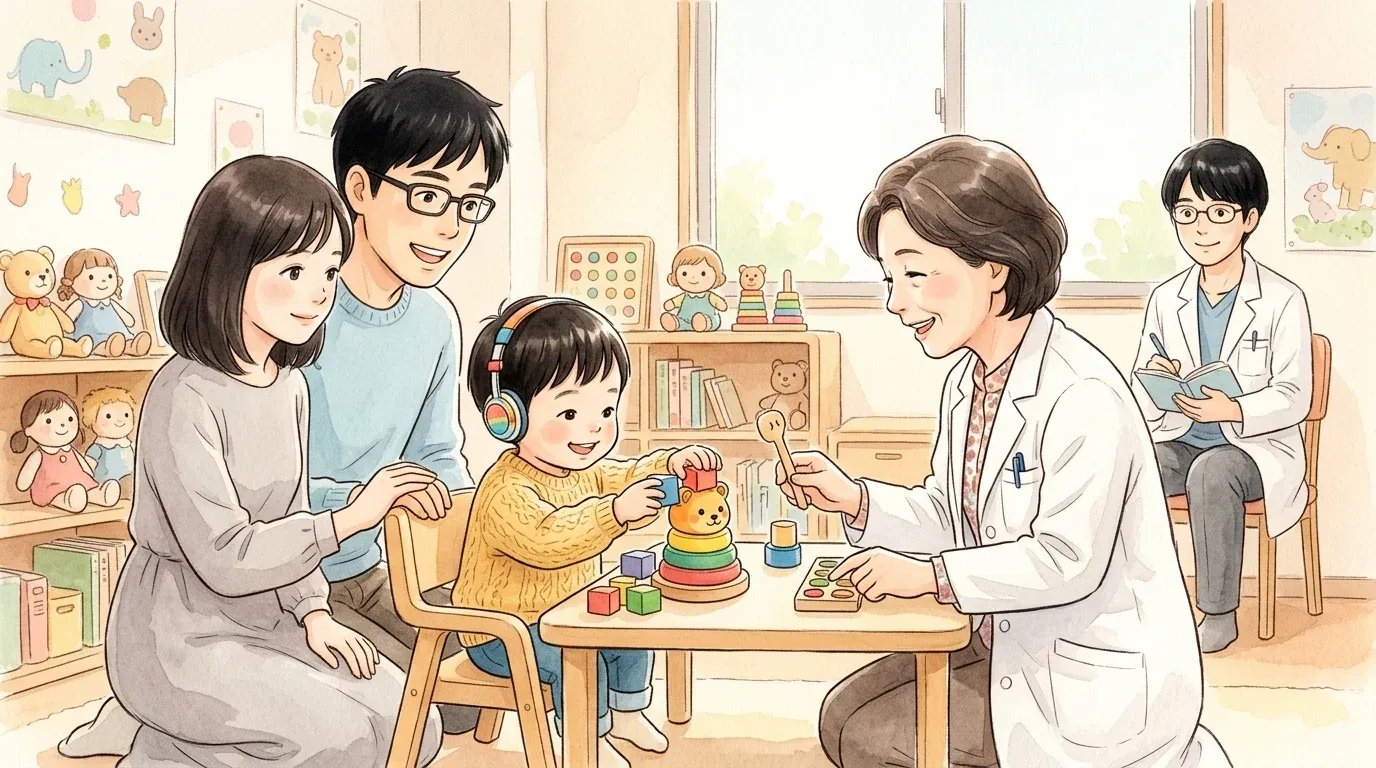
Every six months or so, we have a standing appointment at the hospital clinic for our two-and-a-half-year-old son. He was born with congenital hearing loss in his left ear. Because of that, keeping up with regular checkups is an essential part of our routine. We want to ensure his right ear remains completely healthy and monitor his overall hearing so that he can continue to communicate and explore the world without unexpected setbacks.
The Clock That Switched Backward
When we arrived at the clinic the day before yesterday, the first thing that caught our eye was the waiting room clock. It was completely out of sync with the time displayed on our phones.
Here in our area, Daylight Saving Time (winter time shift) changes had recently been eliminated, but the hospital’s internal wall clocks apparently still ran on an automated schedule. As a result, the clock had automatically rolled back by an hour. This didn’t cause chaos, but it certainly led to quite a bit of communication hassle with the staff, and our scheduled appointment ended up being pushed back by an hour due to the time difference.
In the Exam Room
After waiting for around twenty to thirty minutes in the sub-waiting area, the audiologist came out to greet us, accompanied by a resident physician.
The doctor was exceptionally patient, taking plenty of time to sit down with us, ask about our son’s recent speech development, and understand how he responds to sounds in daily life. Navigating healthcare here in North America, this is something I always appreciate: doctors rarely rush through patient history, taking real care to listen. The resident alongside was equally professional. She observed quietly with an attentive, warm smile throughout the entire visit, learning the workflow without interrupting.
The doctor spent about ten minutes using two or three specialized instruments to thoroughly inspect both of his ears, checking for fluid buildup or physical changes. The results were consistent with his previous visits: his left ear still has complete hearing loss, while his right ear remains healthy and normal.
Next, we stepped into a soundproof booth for a hearing test game. The doctor used play audiometry—introducing faint, calibrated sounds through headphones and speakers to see if he could recognize them. To my pleasant surprise, our little boy caught on almost immediately. At just two and a half, his comprehension was sharp; he grasped the rules right away and cooperated happily with the doctor’s cues. The entire assessment took about thirty to forty minutes, smooth and reassuring.
Dedication on Wheels
Beyond the clinical exam, the moment that stayed with me the most happened before we even reached the department.
When we first arrived, we checked in with the front desk. The receptionist on duty was a young woman in a wheelchair, looking to be around thirty. While checking in, I casually asked her whether the hospital offered seasonal flu shots on-site. At that moment, she didn’t have an exact answer and said she wasn’t sure.
We thanked her and walked down the long corridor toward the audiology department, about two to three hundred meters away.
Just as we arrived at the clinic doors, someone called out behind us. We turned around, and there she was—the receptionist had wheeled herself all the way down the hallway, navigating the busy corridors just to catch up with us. A bit breathless, she told us that she had called around, verified the clinic location, and brought us the exact details on where we could get our flu shots.
I was deeply moved. Facing her own physical challenges, she brought a level of passion and pride to her work that went far beyond what anyone could have expected. Her diligence, empathy, and professionalism left an impression on me that will stay with me for a very long time.